

ZED Isaac™ Sim Extension Overview
ZED Isaac™ Sim Extension Overview
Build, test, and train your physical AI before the hardware even exists.
The ZED Camera extension brings faithful digital twins of every ZED camera into NVIDIA® Isaac™ Sim’s photorealistic simulation. Your simulated ZED streams data to the ZED SDK exactly like a real camera would, so the exact software you ship (perception, navigation, your ROS 2 stack) runs unchanged against the simulator. Iterate on your robot in a fully repeatable virtual world, then deploy to the field with confidence.
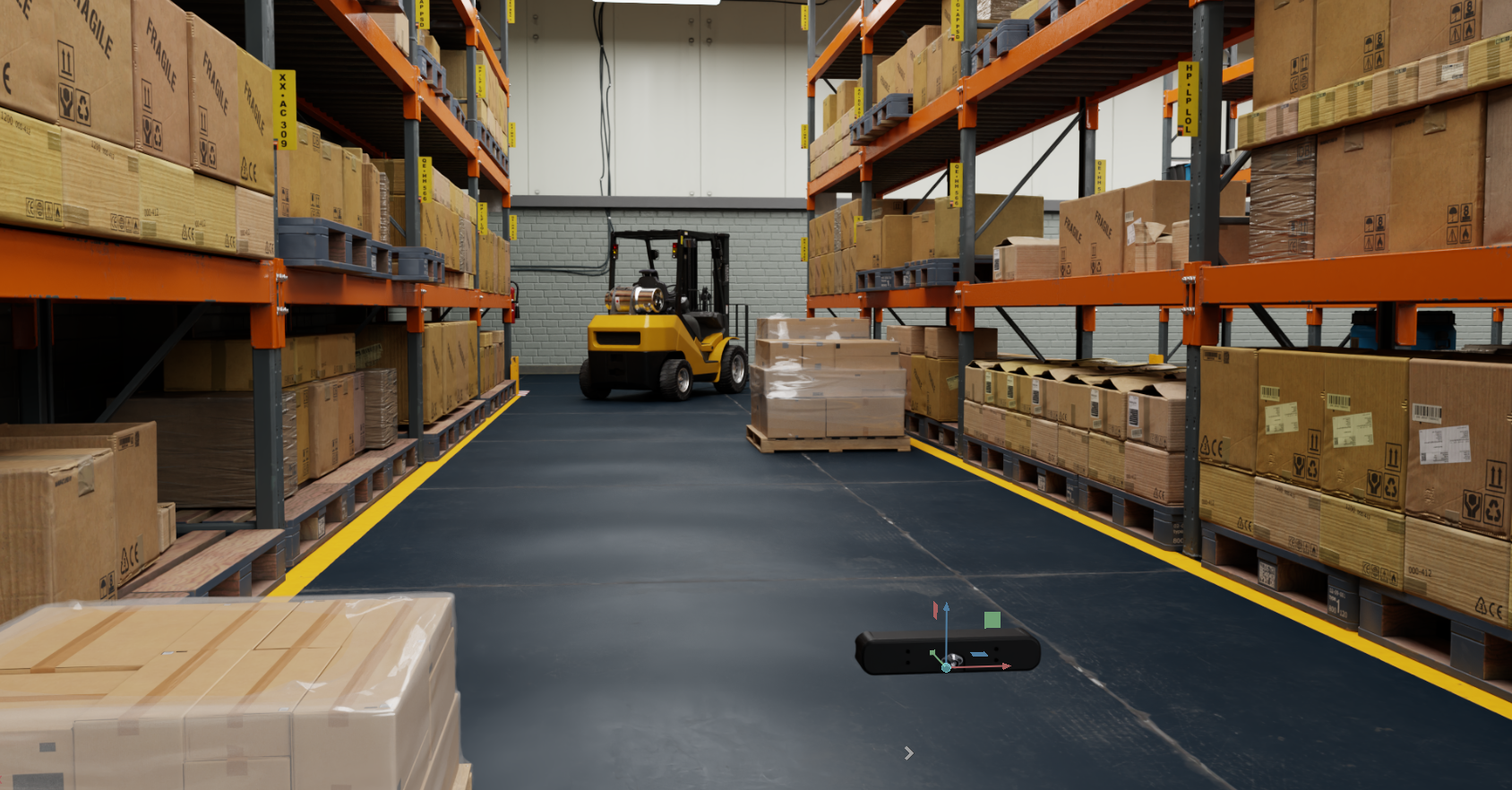
What you get:
- ✅ Every ZED camera as a calibrated digital twin: stereo and mono models, with their lens variants
- ✅ Stereo images + IMU streamed to the ZED SDK and ZED ROS 2 Wrapper, with zero code change
- ✅ Ground-truth depth streaming, straight into your ZED SDK pipeline
- ✅ ZED Sim2Real, a realistic camera model that adds real-world imaging on top of the clean render (experimental)
- ✅ ZED observations as GPU tensors in Isaac™ Lab, for reinforcement & imitation learning
- ✅ SDK-free RGB + depth capture for quick synthetic datasets
- ✅ Multi-camera streaming: several cameras on one robot or a whole fleet in one scene, stereo and mono mixed, all streaming simultaneously
- ✅ Low-latency IPC streaming and virtual stereo pairs
Why simulate your ZED?
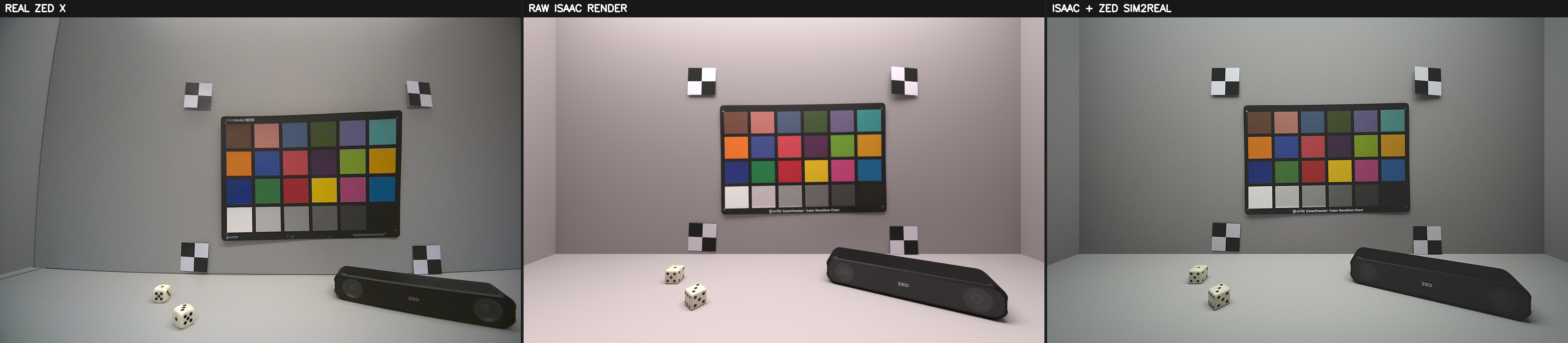
Left: real ZED X. Middle: raw Isaac™ Sim render. Right: the same render with the ZED Sim2Real model applied.
Choosing a data path
Whatever your workflow (sim-to-real validation, robot learning, or dataset generation), there is a data path for it:
Only the streaming path involves the ZED SDK and its stereo-matched depth; the other two deliver Isaac™ Sim’s ground-truth renderer depth.
Get started
Get your first simulated ZED streaming in a few steps: install Isaac™ Sim, the ZED SDK, and the ZED Camera extension, then drop a ZED into your scene and press Play.
This is documentation for the ZED Camera extension >= 5.0.0, which targets NVIDIA® Isaac™ Sim 6.0 (Kit 110.1.2). Extension 4.x targets Isaac™ Sim 5.0, 3.x targets 4.5, and 2.x targets 4.0; see the compatibility table.
You can find the documentation for older versions here.